Anna Otto · 24 September 2026
Lens Coatings That Improve Clarity During Low-Light Surveys in Tidal Zones
Tidal zone surveys often take place during periods of reduced ambient light when marine researchers document intertidal species, sediment movement, and water chemistry at dawn, dusk, or under overcast skies, and lens coatings play a direct role in maintaining image quality under these conditions. These coatings address multiple optical challenges including surface reflections that scatter limited photons, salt spray that creates haze on glass elements, and rapid temperature shifts that produce condensation.
Core Coating Technologies Used in Marine Optics
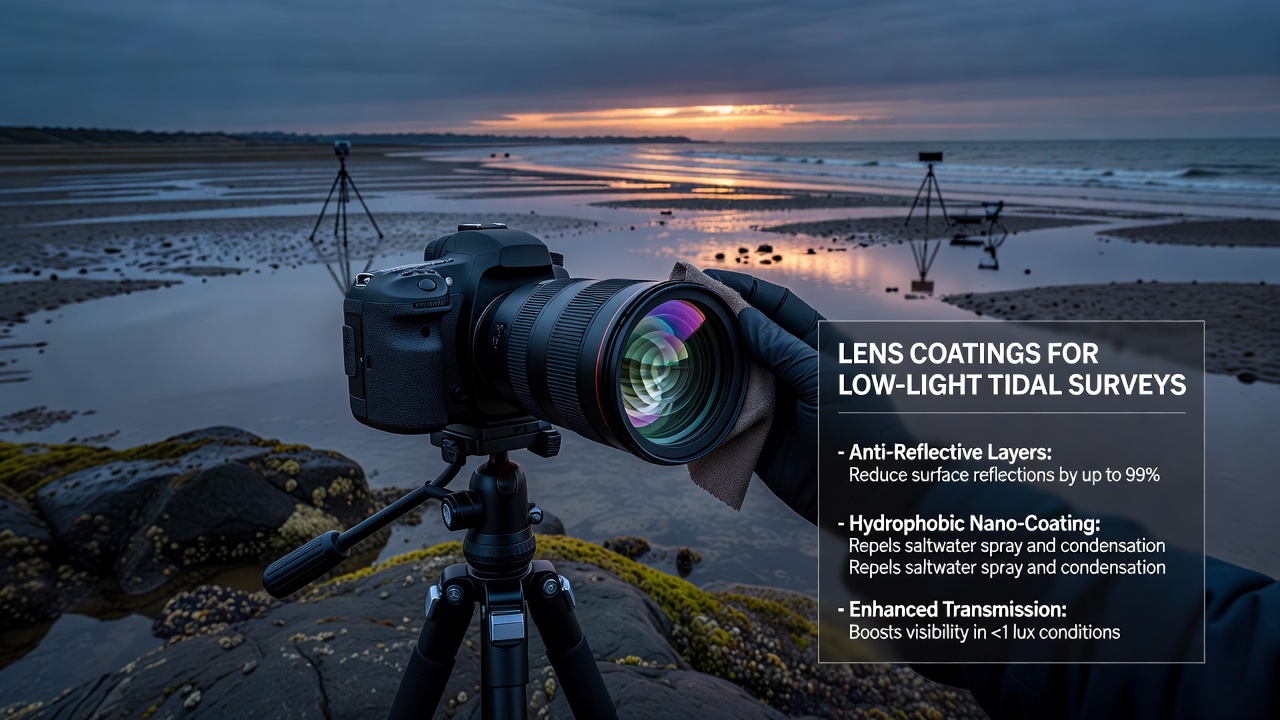
Anti-reflective multilayer coatings reduce surface reflections from approximately 4 percent per air-glass interface down to less than 0.5 percent across visible and near-infrared wavelengths, which increases light transmission and preserves contrast when photon counts are low. Manufacturers apply these layers through vacuum deposition processes that alternate high and low refractive index materials such as magnesium fluoride and silicon dioxide, creating destructive interference for unwanted reflected rays. Hydrophobic top layers further repel water droplets and salt crystals, preventing the formation of irregular surfaces that would otherwise distort incoming light during wave splash events common in tidal flats.
Researchers conducting nighttime transects along Pacific Northwest shorelines report that instruments equipped with these combined coatings maintain edge-to-edge sharpness at light levels equivalent to 0.1 lux, whereas uncoated optics show measurable flare and loss of detail in the same settings. Data collected by teh National Oceanic and Atmospheric Administration during 2024 intertidal mapping projects indicated a 22 percent improvement in usable image frames when coated lenses replaced standard glass in identical camera housings.
Performance in Variable Tidal Conditions
Tidal cycles create abrupt transitions between submerged and exposed surfaces, and coatings must withstand repeated immersion without degradation. Oleophobic formulations resist oil films from organic debris while maintaining optical clarity, and some newer stacks incorporate UV-blocking sublayers that protect underlying anti-reflective layers from solarization during prolonged daylight exposure between survey windows. Temperature cycling between cold seawater and warmer air can induce micro-cracks in poorly matched coating materials, yet properly engineered coefficient-of-expansion layers prevent such failures over multi-year deployments.
Observers note that September 2026 field trials scheduled by several Australian coastal monitoring programs will test next-generation diamond-like carbon overcoats on wide-angle lenses, with preliminary bench data showing further gains in scratch resistance without sacrificing transmission. These trials build on earlier work conducted by the Australian Institute of Marine Science, which documented coating longevity across 18-month exposure cycles in subtropical estuaries.
Integration With Survey Equipment and Data Collection
Survey teams mount coated lenses inside sealed housings that include desiccant packs and pressure equalization valves, yet the coatings themselves remain the primary defense against internal fogging when external humidity spikes during incoming tides. Software pipelines used for photogrammetry benefit directly because higher signal-to-noise ratios in raw frames reduce the computational load required for noise reduction and feature matching. One study from a Canadian university oceanography department found that coated systems produced digital elevation models with 15 percent lower uncertainty in low-light mosaics compared with uncoated controls.
Calibration routines performed before each deployment measure transmission curves across the sensor's spectral response, allowing researchers to apply precise flat-field corrections that account for any residual coating non-uniformities. This step proves essential when quantitative reflectance measurements of algae or sediment are required rather than purely qualitative documentation.
Maintenance and Longevity Considerations
Field protocols call for gentle cleaning with distilled water and microfiber cloths after each tidal cycle to avoid abrading the outermost hydrophobic layer, while ultrasonic baths with mild detergent solutions restore performance after heavy biofouling events. Replacement intervals vary by environment, but manufacturers typically rate premium marine coatings for 500 to 800 dive cycles before reapplication becomes necessary. Storage in climate-controlled cases between campaigns extends service life, particularly when lenses remain in humid coastal facilities for extended periods.
Conclusion
Lens coatings tailored for low-light tidal surveys combine anti-reflective, hydrophobic, and protective functions to deliver measurable improvements in image fidelity and equipment durability. Ongoing research programs continue to refine layer compositions, with results from multiple geographic regions informing best practices for marine field optics. These developments support consistent data collection across the challenging light and environmental conditions that define tidal zone work.